

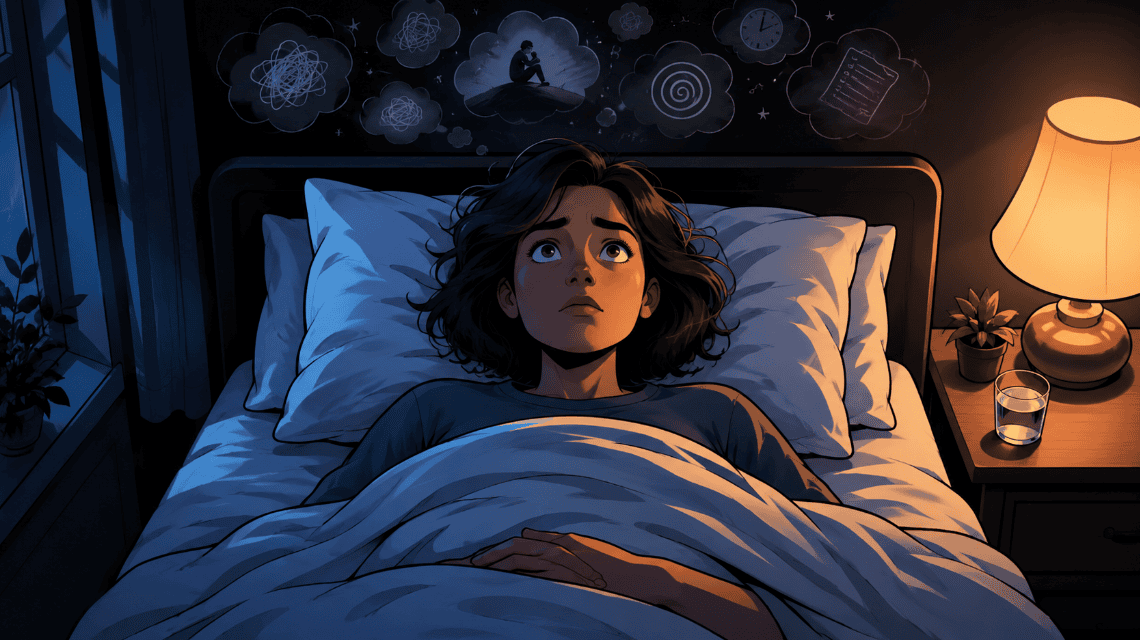
You’re fine all day. Busy, distracted, functional.
Then the lights go off and your brain decides it’s the perfect time to replay every awkward conversation you’ve had since 2014.
If that’s you, you’re not broken. You’re just quiet enough, finally, for your brain to catch up with itself.
Why Nighttime Is Anxiety’s Prime Time
During the day you have inputs: emails, conversations, traffic, noise. All of it competes for your attention.
At night, the competition disappears. Your anxious thoughts don’t have to fight for airtime anymore. They get the whole stage.
This isn’t a coincidence. It’s an empty room with an open mic, and your anxiety loves an open mic.
Stop Trying to “Not Think About It”
Telling yourself not to think about something is like telling yourself not to think about a pink elephant.
It backfires immediately.
Try this instead: give the thought a scheduled slot. Keep a notepad by the bed. Write the worry down, tell yourself you’ll deal with it tomorrow at a specific time, and actually mean it.
Your Body Doesn’t Know the Difference
Racing heart. Shallow breath. Tight chest. Your body reacts to a 2am spiral the same way it reacts to an actual threat.
It doesn’t know the “threat” is an email you sent six hours ago.
Breathe Longer on the Exhale
Most people breathe evenly, in and out. For anxiety, that’s backwards.
Try this: inhale for four counts, exhale for six. The longer exhale activates your parasympathetic nervous system, the “calm down” switch your body has built in.
Do it for two minutes. It feels almost too simple. It works anyway.
Cold Feet, Warm Body
Anxiety runs hot. Cool extremities can help regulate it.
Try this: socks off, one foot outside the blanket. Small, but it gives your nervous system a temperature cue that something is settling down.
Name It Instead of Fighting It
“I’m having an anxious thought” is a different sentence than “something is wrong.”
The first one is true and manageable. The second one is a spiral waiting to happen.
You don’t have to solve the anxiety. You just have to stop arguing with it.
Nighttime anxiety isn’t a character flaw or a sign you’re falling apart. It’s your brain finally getting a quiet room to work in, and forgetting that quiet rooms are for resting, not rehearsing every worst-case scenario you own.
Give it a smaller job. Watch it get bored eventually.






Lorem ipsum dolor sit amet, ad dolor diceret erroribus eos, ut est nisl summo sententiae
Lorem ipsum dolor sit amet, vel in viderer invenire, eu vim primis disputationi. Quaerendum vituperatoribus eam in, at vero insolens duo, mucius probatus sed id. Id augue albucius vel, ad est facer bonorum, mea principes consulatu et.
Veniam fabulas facilisi cum ne, ad vero dolorem quo, duo modus scripserit reformidans id.